Body Politic
How the Feast of Corpus Christi evangelised me

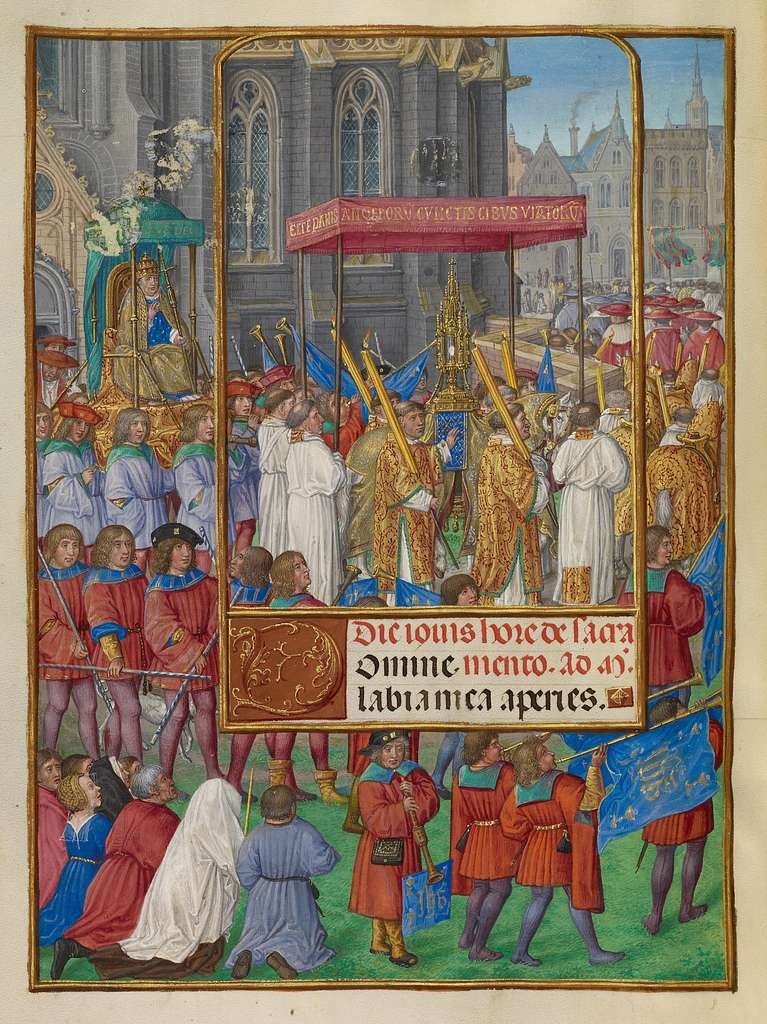
The process by which I began to find Christian faith compelling - rather than something to be rejected a priori - was cumulative and slow. But one moment felt decisive.
On a quaint little street full of boutique shops on a sunny day, I must have been drinking coffee out of a takeaway cup, putting off my undergraduate work, all whilst sat in a sort of arcade formed by the ridge of a brutalist building jutting over the pavement. Onto this backdrop of ephemeral modernity burst a figuration of eternity. Gradually, came the peeling of little bells; the chugging of incense smoke. Appearing and disappearing between columns was a velvet canopy, held aloft by servers in white tunics. It was all trailed by a crowd, softly singing a hymn. The whole thing had the kind of tubular, inching locomotion of a caterpillar. It sloped off around the next turn to continue its journey, having transported all of us on that street, for just a few moments, to the third heaven.
Corpus Christi, or ‘body of Christ’ is a feast day that takes place on the Thursday after Trinity Sunday - this year, transferred by the Church to today, Sunday 7th June. It’s something that has been going on for almost three quarters of a millennium now. Thousands of British Catholics will have paraded down Piccadilly Circus in London, or Moor Street in Birmingham, behind a shrine containing, in their eyes, God Himself. This essay is for anyone who has clocked one such procession today and thought: what’s it about?
It all started when a Belgian nun had a dream about the moon. Around 1208, St Juliana of Liége - like Pope Leo XIV, an Augustinian - was given a vision of the white moon with one occluded segment. After twenty years, Jesus himself explained it all to her in another dream. The lunar blemish represented the one feast day that the Church calendar was apparently lacking: an annual celebration of Christ’s body, present in the bread consecrated at every Mass.
This selenic jigsaw was not to be quickly completed. Holy days of importance could not just be added at the drop of a hat, and a grassroots campaign to formalise one would need patrons with institutional clout. Thankfully for Corpus Christi, the Bishop of Liége got wind of Juliana’s dream and, after careful theological consulting of the scholars at Paris, implemented a local diocesan feast in the name of the Lord’s body and blood, in 1246.
By October, however, the Bishop was dead - and, without his backing, the newbie festival might easily have been banished to the footnotes of liturgical history as a minor provincial experiment. St Juliana - always a controversial figure - was in no position to rally for her cause now, having been ousted from her own convent by a faction unsympathetic to the reform-minded mysticism she represented, and was now effectively sofa-surfing at the Cistercians.
It’s possible to see bigger historical trends at work here, in that Medieval church authorities never knew quite how much credence to give to such ecstatic, visionary spirituality – popular, and even orthodox, though it could be – when it came from laypeople. The church machine could occasionally be too jittery about anything with a do-goody, reforming aura, in case it proved a thin end of a wedge.
On this occasion, however, St Juliana’s vision proved irrepressible. Its potential was great for underscoring a dogmatic point in constant need of being made in the face of various heresies: that, at every Mass, was offered the literal body and blood of Christ. Now, it just needed the right backers. When the Corpus Christi prototype took place in Liége in 1246, a man named Jacques Pantaléon happened to be present for the proceedings. He became Pope Urban IV just fifteen years later, in an appointment that would dramatically change the trajectory of the festival. He would elevate a one-off in Liége to a day of universal observance - a papal first. No calendar highlight had needed an after-the-fact foundation brought about by intervention from the Holy See before, as they were generally held to have developed organically out of the events of salvation history. Then again, the Lord’s moon metaphor was as direct a revelation as one could ask for.
A bull, Transiturus de hoc mundo, was promulgated on 11th August 1264, as well as a liturgy that has been traditionally ascribed to St Thomas Aquinas. It ordered
That each year, then, a special and solemn feast of such a great sacrament be celebrated, in addition to the daily commemoration that the Church makes of it, and we establish a fixed day for it, the first Thursday after the eighth of Pentecost. We also establish that on the same day devout crowds of faithful gather for this purpose in churches, with generosity of affection, and all the clergy and people, joyful, sing songs of praise, that lips and hearts be filled with holy happiness; sing faith, tremble hope, exult charity; throb devotion, exult purity; let hearts be sincere; that all unite with diligent spirit and prompt will, taking care of preparing and celebrating this party. And may heaven fervor inflame the souls of all the faithful in the service of Christ.
Perhaps anxious that the whole thing could smack of novelty, the Pope devoted space to handling potential objections. First, wasn’t Christ’s body and blood already the focus of every single mass? What need was there of a mass about the mass? Urban pointed out that holy days are like that in general - we have lots of pious duties to honour saints or commemorate God’s plan of redemption every day of the year, just like we might offer the mass on every day. But setting aside one bespoke public day for a saint or event is like a guarantee that we collectively fulfil our duty; it’s a way of putting it on the common agenda at least once per annum. It makes up for the other 364 days of potential neglect.
Secondly, and more devastatingly, wasn’t there already a specific day to commemorate Holy Communion - Thursday of Holy Week, the commemoration of the Last Supper? That would surely have pipped Corpus Christi to the post. But Urban argued that Maundy Thursday has a lot going for it - chrism, footwashing and the like. Eucharistic presence is arguably knocked from centre there. Corpus Christi would correct that.
Misfortune struck again, however, when Pope Urban IV died in September of that year. Orders had not yet fully been dispatched. And since they didn’t come out of Rome, but from a roving papal court in Orvieto lacking in robust administrative machinery, the news about this calendar addition was prevented from getting out quickly and efficiently. It was a launch phase straight out of a PR specialist’s nightmares - momentum collapsed, and the thing lay on the statute books for the rest of the thirteenth century without anyone seemingly acting on it.
The vital nudge came in 1317. Pope John XXII clearly had reasons for reopening this cold case; he was a great devotee of St Thomas (he would canonise him in 1323), and Corpus Christi was duly repromulgated in November from Avignon. References to celebrations in England spring up in the sources for the very next year, in places like Gloucester, and Wells. By 1400, there is not a corporation or parish or Scottish burgh with records that does not document its observance. It had been well over a century since St Juliana’s dream, but finally the pieces of the moon had fallen into place.
Local guilds sprung up entirely for the sake of organising the yearly procession of the Blessed Sacrament relatively early - there is one in Ipswich by 1325. In the cities, they were grand affairs, and a chance for civic dignitaries to strut their stuff: the Mayor of Leicester is listed as a canopy bearer in the late 1400s - perhaps the best position he could take within the procession without the chore of becoming ordained. Behind these grandees came clergy, laypeople, candles, pictures, flowers, banners and even (in Norfolk, 1493) a large model of a monster.
Of course, what was spelt out in such a public ritual was the story of “us”. Here was, for example, an entire municipality coming together in an ordered way, expressing a conviction that everything had its place. Everything was in orbit around a sacred singularity, and people stood in their city’s procession in a way that spoke of their place in a schema. The object they heralded before them – Christ’s literal body – was the ultimate reminder that all things fitted into a master narrative; history had culminated in this object - this incomprehensible condescension of the divine love to ‘hand itself over’ to sinful humanity in order to raise them up. All who recognised it as such belonged together in a pan-national movement that had converted the entire world. And, while cities certainly found the logistics of a large procession easier, there is evidence that larger towns ensured their processions went out into the remoter provinces. The bounds were well and truly beaten.
Organised fun inevitably led to amateur dramatics. Starting with one-off presentations of biblical episodes, places like York would develop repertoires of over fifty plays for Corpus Christi day, with scenes depicted on top of moving carts that wheeled their way through the jubilant city, each performed by a different craft guild. The Bakers would do the Last Supper, for example; the Butchers the burial of Jesus in the tomb. And here was the birth of English theatre. Shakespeare never read Aeschylus, but he certainly read these scenes of Noah’s wife refusing to board the ark, or Satan losing a fistfight for the souls in Hell. It is hard not to think that they are the theatrical forerunners that nurtured the Bard’s instinct for blending bawdy and tragic, profane and sacred.
It was not to last. In the summer of 1547, Edward VI’s parliament was empowered to seize the endowments of the religious guilds that were the lynchpins of Corpus Christi practice. By 1549 they were all but expunged. The theatrics could defensibly be seen as a separate affair, and not necessarily hostile to the new reformed religion of England; the plays of Coventry and York limped on, though often by running censored material that did not aggravate the new establishment sensibilities. There was a brief resuscitation in 1554 due to a royal proclamation (Queen Mary was a keen sponsor of the festivity - she led her palace’s procession in 1555). Sadly, an innocence had been lost. The world was now too fractured to permit this artefact of unified Christendom; this herald of social, and even cosmic, unity. Fittingly, an angry protester tried to snatch the sacrament from the procession in Smithfield that year. An era had ended.
By 1559, performances of Corpus Christi plays were virtually prohibited in England. Some communities defied the new religious tide. But by the 1570s even the hardwired pageantry of Coventry and York had come to a halt. Craft guilds diverted their energy to artistic celebrations less likely to get them into trouble with the authorities, like midsummer. By 1600, only Kendal apparently retained a cycle of plays as a remnant of an old England. The head burgher did his best to defend the practice to the northern commission at York, but by James’ reign in 1605, the town council had presumably received a final cease and desist, as the records vanish after this.
The driver for this change was ideological protestantism, plain and simple. Traipsing after a piece of bread was idolatrous; doing little pageants about the Lord’s life demeaned Him. Corpus Christi parades returned to England only when legal persecution abated for Catholics in the 19th century. When precisely? The case for an official return of Corpus Christi parading can be made for June 10th, 1844 in Aston, Staffordshire - owing to the labours of Bl. Dominic Barberti, the Italian Passionist who would receive St John Henry Newman into the Catholic Church in 1845.
This is partly what gives Corpus Christi its strange power today: the fact that it is coded as a fringe activity; the ritual of a ghettoised sect, creeping around the secular polis. Its register is perhaps even one of resistance. And yet, the truth be told, the parade emerged from a confident Catholic society maximally asserting itself as a beneficiary of divine grace. It is a strange irony that the parades enact a suspension of ‘things as they ought to be’ today - as it certainly seemed to my curious eyes when I first beheld it all those years ago. Those people were not doing as they ought, if they had any sense. And yet, taking part in them these days, I feel the opposite. Here is, in fact, humanity where it should be, doing exactly what it is made to do: in triumphal procession, united as one, behind its once-for-all-offered and Risen Lord.
Wonderful witness to the “ghettoised sect” processing on Corpus Christi in Oxford!
Might there be a tiny typo in the anachronistic dating of its revival in Aston, Staffordshire?